

Table of Contents
- How to Measure Your Body for Clothing Accurately
- How to Read a Size Chart and Compare Garment Dimensions
- Vanity Sizing Explained: Why Your Size Varies Across Brands
- Best Online Size Finder Tools and AI-Powered Shopping
- Reading Customer Reviews for Sizing Advice and Fit Confidence
- Finding Your Perfect Fit Online: A Step-by-Step Strategy
- Common Mistakes to Avoid When Shopping Online
- Post-Purchase Alteration Hacks for the Perfect Fit
Last Updated: August 10, 2026
How to Measure Your Body for Clothing Accurately
Accurate measurements are the foundation of finding your perfect fit online. Without precise numbers, even the best size chart becomes unreliable.
Start with a flexible tape measure, rigid rulers and string won't give you the accuracy you need. Wear fitted undergarments or minimal clothing when measuring, as loose layers distort your actual dimensions. Stand in front of a mirror to ensure the tape sits parallel to the ground and isn't twisted. Have someone help if possible, especially for back and shoulder measurements.
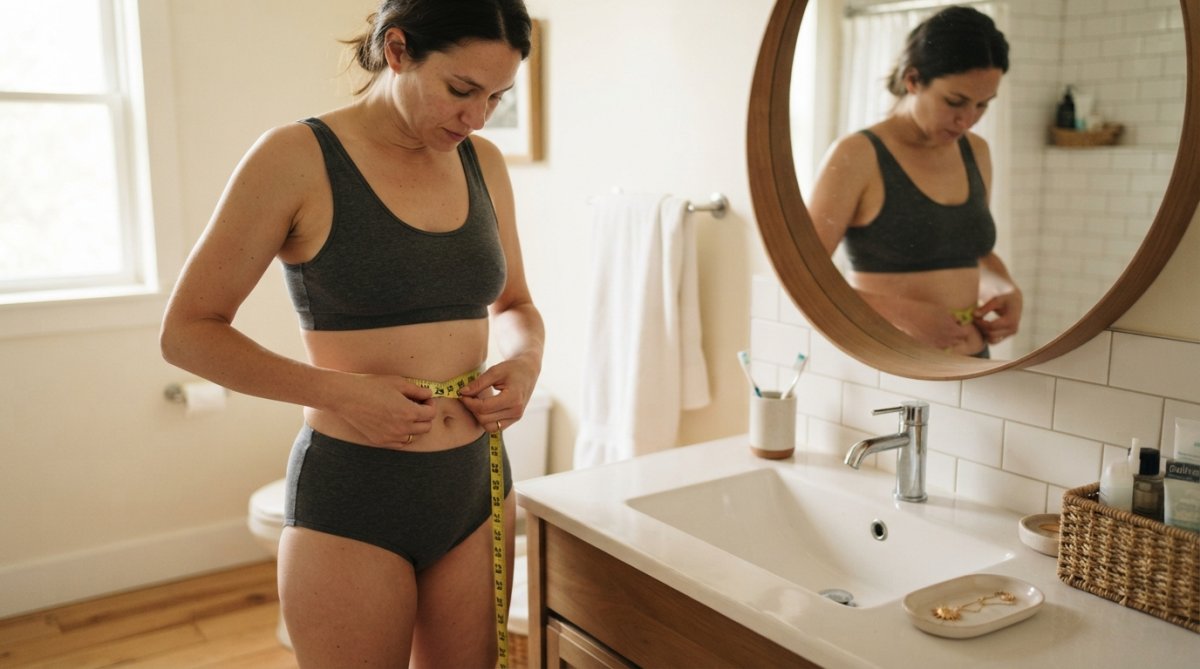
Record each measurement twice. If the numbers differ, measure a third time and use the middle value. Write everything down immediately.
Essential Measurements: Chest, Waist, and Hips
Chest measurement is taken at the fullest part of your bust or chest. Wrap the tape around your back, under your arms, and across your chest. Keep the tape snug but not compressing your body.
Waist measurement should be taken at your natural waist, about an inch above your belly button. This is where most clothing brands measure for fit, even if the finished garment sits lower.
Hip measurement is taken at the fullest part of your hips and buttocks with feet together. This determines how much room a garment has through the seat and thighs. Many online shoppers skip this step, then find that bottoms fit the waist but are too tight through the hips.
These three core measurements form the basis of most size charts.
Inseam and Length Measurements
Inseam is the distance from your inner thigh to your ankle. Wear the shoes you plan to wear with the pants, as heels change the inseam length. Measure along the inside of your leg from your crotch to the top of your shoe.
Overall length for tops is measured from the back of your neck down to where you want the garment to end. For dresses, measure from your shoulder to your desired hem length.
Shoulder width is measured from the outermost point of one shoulder to the outermost point of the other. Garments that are too narrow in the shoulders will feel restrictive regardless of chest size. Brands vary widely on shoulder width.
How to Read a Size Chart and Compare Garment Dimensions
A size chart is only useful if you compare your measurements directly to the garment dimensions, not to the size label. A brand's "Medium" might be cut larger or smaller than another brand's "Medium," but the actual chest width, length, and sleeve measurements don't lie.
If you measure a 38-inch chest and the size chart shows the Medium has a 39-inch chest width, that Medium will fit. If the Large is 41 inches, it will be loose.
Pay attention to how the brand measures. Some measure garments laid flat; others measure on a dress form. Most size charts include an illustration showing where each measurement is taken.
Look for stretch factor in the size chart notes. A 95% cotton, 5% spandex shirt will fit differently than 100% cotton in the same labeled size. If you're between sizes, a stretchy fabric might let you size down; a rigid one might require sizing up.
Vanity Sizing Explained: Why Your Size Varies Across Brands
Vanity sizing is the practice of labeling garments with smaller sizes than their actual measurements. A size 10 today might have a 32-inch waist, but 20 years ago, a size 10 had a 30-inch waist. This creates chaos in online shopping, you might wear a size 8 at one brand and a size 12 at another.
This is precisely why comparing your measurements to the garment dimensions, rather than trusting the label, is your only reliable strategy.
International brands add complexity. A size 40 in Europe is not equivalent to a size 40 in the United States. If you're shopping from an international retailer, their size chart will usually include a conversion guide, but your actual measurements remain the most reliable reference point.
Some brands size consistently; others vary wildly between styles. Check the size chart for each specific garment, not just each brand.
Best Online Size Finder Tools and AI-Powered Shopping
Several retailers now offer AI-powered size finder tools that use your measurements to predict your ideal size across their catalog. When these systems work well, they're genuinely helpful.
The most effective size finders combine your measurements with your body shape. Some tools ask whether you're pear-shaped, apple-shaped, or rectangular. This helps because two people with identical chest and waist measurements might need different fits if their weight distribution differs.
Virtual try-on technology uses your phone's camera to show how garments might look on your body. These tools work best for getting a sense of proportions and colors on your skin tone. They're less reliable for judging actual fit because lighting, camera angle, and the 2D representation of a 3D garment all introduce error.
Look for tools that learn from your past purchases. The more data these systems have about you, the better they perform. However, they're still tools that inform your decision, not replacements for comparing your measurements to the size chart.
Reading Customer Reviews for Sizing Advice and Fit Confidence
Customer reviews are your most honest source of fit information. Reviewers describe how garments actually fit on real bodies. They mention whether items run small, true to size, or large, and note specific issues like shoulder width or length.
Look for reviews from people with your body type. A review that says "I'm 5'6" and 160 pounds and the Medium fit perfectly" is more useful than a generic "Great fit!" comment.
Pay attention to the balance of sizing comments. If 80% of reviews say a shirt runs small and 20% say it runs true to size, assume it runs small.
Read the critical reviews, not just the five-star ones. People complaining about fit often provide the most specific details. Detailed reviews that mention specific measurements or body types are more credible than generic praise.
Finding Your Perfect Fit Online: A Step-by-Step Strategy
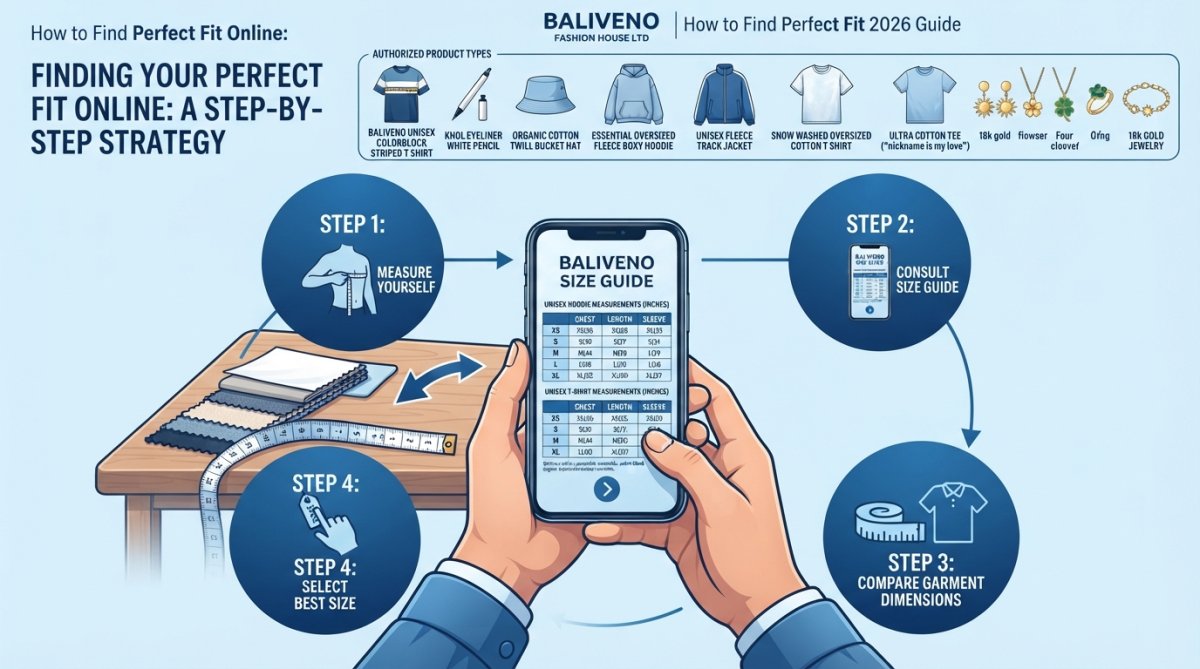
Getting the perfect fit online requires a systematic approach.
Step 1: Gather Your Accurate Measurements
Measure yourself using a flexible tape measure, fitted undergarments, proper positioning, and recorded numbers taken twice. Keep your measurements accessible in your phone's notes app or a spreadsheet.
Step 2: Consult the Brand's Size Chart and Garment Dimensions
Before adding anything to your cart, pull up the size chart. Compare your measurements to the garment's listed dimensions. Don't look at the size label first; look at the actual measurements.
Check whether the brand measures finished garment width or stretched width. Note the length to ensure it matches your preferences.
Step 3: Account for Fabric Composition and Stretch Factor
A garment's fiber content determines how it will feel and fit. Cotton is predictable and doesn't stretch much. Spandex or elastane adds stretch. A 5% spandex blend will have some give; a 10% spandex blend will have noticeably more. If you're between sizes and the fabric is stretchy, size down. If the fabric is rigid, size up.
Some fabrics shrink; others don't. If you're buying a fitted piece, account for this.
Step 4: Check Customer Reviews for Body Shape Analysis
Find reviews from people who describe their body type similarly to yours. Look for specific mentions of which parts fit well and which parts didn't. Count how many reviewers mention fit issues versus how many say it fit perfectly.
Step 5: Use Virtual Try-On Technology When Available
If the retailer offers virtual try-on, use it. Take the photo in natural lighting. Wear fitted undergarments so the technology can accurately map your body.
Remember that virtual try-on shows you proportion and color but not actual tactile fit. Use it as one data point, not the final word.
Common Mistakes to Avoid When Shopping Online
The most expensive mistake is ordering without comparing your measurements to the size chart. You'll buy the wrong size, pay return shipping, and start over.
Don't assume brands size consistently. Check the size chart for every brand. Some brands cut generously; others cut slim.
Avoid relying on the size label alone. The garment dimensions are the facts.
Don't ignore fabric content. A 100% cotton shirt and a 95% polyester, 5% spandex shirt labeled the same size will fit completely differently.
Skip ordering multiple sizes "just to try." If you've done the measurement work correctly, you should be confident in one size.
Don't measure yourself in baggy clothes. Measure in fitted undergarments or minimal clothing.
Avoid measuring yourself when you're bloated, tired, or at an unusual weight. Measure when you're at your normal baseline.
Post-Purchase Alteration Hacks for the Perfect Fit
Sometimes a garment fits 95% perfectly but needs one small adjustment.
Hemming is the most common alteration. If a dress or pants leg is slightly too long, a tailor can shorten it for $15-40. If the length is the only issue, hemming is often cheaper than return shipping and reordering.
Taking in seams is possible for garments that are slightly too loose. A tailor can take in the side seams to make a shirt or dress more fitted for $25-60. This works best if the garment is only one size too large.
Tapering sleeves is an option if the sleeve length is right but the sleeve width is too loose for $20-40.
Adding darts or elastic can adjust the fit at the back or sides for $20-50.
Some alterations aren't worth the cost. If a garment is too tight and would require letting out seams, the cost often exceeds the garment's price. In these cases, returning and reordering is usually smarter.
For sustainable-minded shoppers, alterations extend a garment's life and reduce waste.
Finding your perfect fit online is a learnable skill, not a matter of luck. At BALIVENO FASHION HOUSE LTD, we understand that premium, sustainable clothing only delivers value if it actually fits your body. By taking accurate measurements, reading size charts carefully, and learning how your preferred brands cut their garments, you eliminate most of the guesswork. When you do order, you'll have confidence that the piece will work. Start with your measurements today, and your next online purchase will be your best one yet.
| Step | Action | Key Focus |
|---|---|---|
| 1 | Gather accurate measurements | Chest, waist, hips, inseam, length |
| 2 | Consult size chart | Compare your measurements to garment dimensions |
| 3 | Account for fabric | Consider stretch factor and fiber content |
| 4 | Read reviews | Find feedback from similar body types |
| 5 | Use virtual try-on | Check proportions and color in natural light |
Frequently Asked Questions
How do I accurately measure myself for clothing sizes?
Use a flexible tape measure and wear fitted undergarments for accuracy. Measure your chest at the fullest point, waist at the narrowest point, and hips at the widest point. For length, measure your inseam from your inner thigh to your ankle while standing barefoot. Take each measurement twice to confirm accuracy, and avoid pulling the tape too tight. Record measurements in inches for US sizing.
Why does vanity sizing make finding the perfect fit online so difficult?
Vanity sizing means brands intentionally label garments smaller than their actual dimensions to make customers feel better about their size. A size 8 at one brand may fit very differently from a size 8 at another. This is why relying on size alone is unreliable, always compare your body measurements directly to the garment dimensions listed in the size chart, not the labeled size number.
Are online fit finder tools and AI-powered shopping actually accurate?
Modern AI-powered fit intelligence tools have improved significantly, but they work best when combined with your own measurements and customer reviews. These tools analyze body shape, fabric composition, and stretch factor to predict fit. However, they cannot account for personal preference regarding how snug or loose you like clothing. Use them as one data point, not the only source of fit confidence.
What should I do if a brand doesn't have a detailed size chart or garment dimensions?
Contact the brand directly and ask for specific garment measurements: chest width, waist circumference, hip width, sleeve length, and hemline details. Check customer reviews for body shape analysis and how the piece fits different body types. Look for photos from real customers showing how the garment fits on various frames. If the brand won't provide this information, consider shopping elsewhere where fit accuracy and transparency are prioritized.


