

Table of Contents
- What Sustainable Fashion Actually Means for Beginners
- How to Identify Ethical Fashion Brands
- Sustainable Clothing Materials List: What to Buy and What to Avoid
- How to Build a Capsule Wardrobe on a Budget
- How to Care for Clothes to Make Them Last Longer
- End-of-Life Clothing Management: Donate, Resell, or Recycle
- Frequently Asked Questions
Last Updated: September 13, 2026
What Sustainable Fashion Actually Means for Beginners
Sustainable fashion is the practice of designing, producing, and buying clothing in ways that reduce harm to people and the planet, from fiber sourcing through to how a garment is eventually discarded. At BALIVENO FASHION HOUSE LTD, we think of it less as a trend and more as a set of decisions you repeat every time you open your closet.
The core idea is simple: buy fewer, better pieces, wear them longer, and know where they came from. That single shift in mindset is what separates sustainable fashion from the endless cycle of buying and discarding.
Why Fast Fashion's Environmental Impact Matters
Fast fashion's real cost shows up after you've worn something a handful of times. Cheap synthetic garments shed tiny plastic fibers every wash, and those fibers travel from washing machines into waterways, where they're nearly impossible to filter out. When a garment falls apart in months rather than years, it gets replaced, and the whole cycle restarts.
Textile waste is the visible symptom. Landfills fill with clothing that was never built to last, and the energy, water, and labor that went into making it are wasted along with it. Buying intentionally, even occasionally, interrupts that loop.
Key Terms: Slow Fashion, Circular Economy, and Greenwashing
Slow fashion is an approach that prioritizes quality, durability, and ethical production over speed and volume, encouraging fewer purchases that last longer.
Circular economy describes a system where materials are kept in use through resale, repair, and recycling instead of being thrown away after one owner.
Greenwashing is when a brand markets itself as eco-friendly without real evidence, using vague words like "natural" or "conscious" while changing nothing about how the clothes are made.
How to Identify Ethical Fashion Brands
The fastest way to identify an ethical fashion brand is to check whether it publishes specifics: fiber content, factory locations, and certifications. Vague mission statements are easy; verifiable supply chain transparency is not.
Ask three questions before you buy:
- Does the brand name the materials and their source?
- Does it disclose where garments are manufactured?
- Does it offer repair, resale, or take-back options?
If a brand answers all three, it's worth your attention. If it dodges, keep looking. The Federal Trade Commission's Green Guides set the standard for how environmental marketing claims should be substantiated, which is a useful benchmark for judging whether a label's language holds up.
Certifications and Supply Chain Transparency to Look For
Certifications matter because they're verified by outside parties, not self-declared. Look for recognizable marks that cover organic fiber content, fair labor practices, and responsible manufacturing. Supply chain transparency goes a step further: the best brands can trace a garment from raw fiber to finished piece.
A few certification families are worth knowing by name:
- Organic fiber content, certifications such as GOTS (Global Organic Textile Standard) cover the fiber from harvest through processing, and USDA Organic applies to raw agricultural fiber.
- Responsible wool and down, programs like RWS (Responsible Wool Standard) and RDS (Responsible Down Standard) trace animal welfare through the supply chain.
- Recycled content, the Global Recycled Standard (GRS) verifies the percentage of recycled material in a garment.
- Fair labor, Fair Trade Certified and SA8000 address factory working conditions rather than fiber.
- Chemical safety, OEKO-TEX STANDARD 100 tests finished textiles for harmful substances.
How to Spot Greenwashing in Practice
Greenwashing rarely looks like an outright lie. It usually shows up as a true-but-irrelevant claim. A polyester shirt labeled "made with recycled materials" may still shed microplastics. A "conscious collection" may be one capsule line inside a catalog of thousands of conventional pieces. A "natural" fiber claim says nothing about how the fiber was grown or who sewed the garment.
A practical test: ask whether the claim is specific, verifiable, and material to the garment's actual impact. "100% GOTS-certified organic cotton, sewn in a Fair Trade Certified facility" passes. "Eco-friendly fabric" does not. The FTC's Green Guides exist precisely because broad environmental claims are easy to make and hard to prove.
The Trade-Offs Nobody Advertises
Even well-intentioned brands face real constraints. Organic cotton uses less synthetic pesticide but still requires significant water. Recycled polyester diverts plastic from landfills but still sheds fibers in the wash. Small brands with transparent supply chains often can't match the prices or size ranges of large ones. Knowing these trade-offs helps you judge a brand on what it actually does rather than what its marketing implies.
Sustainable Clothing Materials List: What to Buy and What to Avoid
Natural fibers such as organic cotton, linen, and wool are generally the better starting point because they're renewable and break down more readily at end of life. Synthetic fibers like polyester and nylon are petroleum-based and shed microplastics with every wash.
| Material | Type | Best For | Watch Out For |
|---|---|---|---|
| Organic cotton | Natural | Everyday basics | Needs water to grow |
| Linen | Natural | Warm-weather wear | Wrinkles easily |
| Wool | Natural | Cold-weather layers | Requires careful washing |
| Recycled polyester | Synthetic | Activewear | Still sheds fibers |
| Virgin polyester | Synthetic | Cheap fast fashion | Microplastic shedding |
Natural Fibers vs. Synthetic Fibers and Microplastics
The natural-versus-synthetic divide comes down to what happens during use and after disposal. Natural fibers like organic cotton and linen biodegrade over time and don't shed plastic particles. Synthetic fibers shed microplastics in the wash and persist in the environment for decades.
That doesn't mean synthetics are always wrong. Recycled polyester has a place in durable activewear where natural fibers can't perform. The problem is volume: when synthetics dominate a wardrobe built for quick turnover, the shedding adds up fast.
How to Build a Capsule Wardrobe on a Budget
A capsule wardrobe is a small, coordinated set of versatile pieces you actually wear, usually somewhere between 20 and 40 items. The goal isn't deprivation; it's removing the decision fatigue and impulse buys that fill closets with things nobody wears.
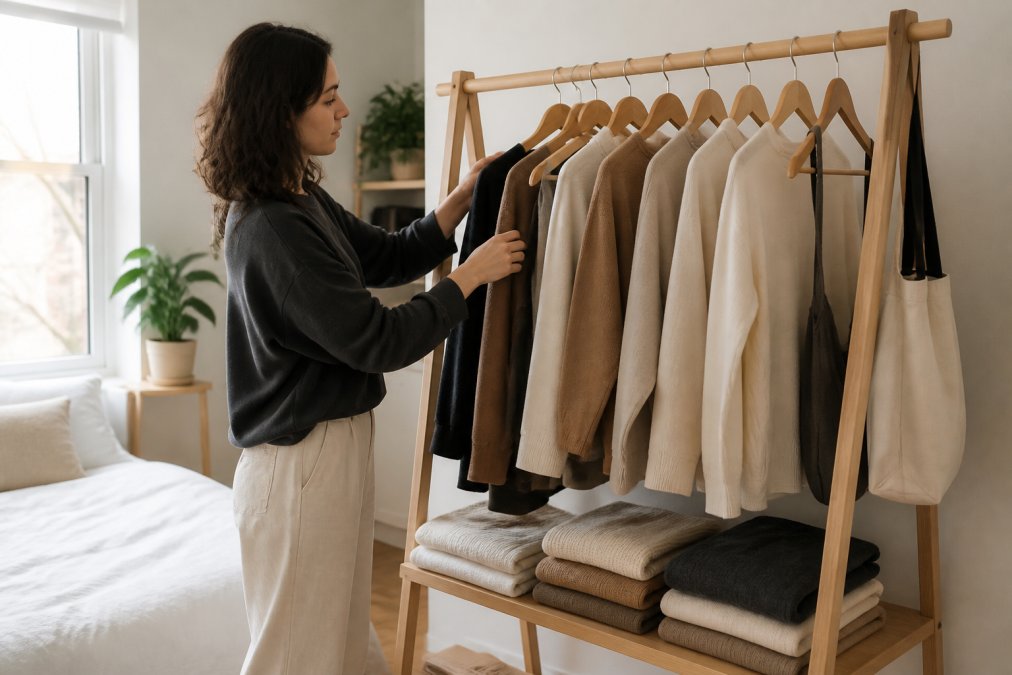
Start by choosing a neutral base, then add a few pieces that work across seasons. A quality unisex sweatshirt or a well-made tee earns its place because it pairs with nearly everything. When you buy fewer pieces, you can afford to care about how each one is made.
Cost Per Wear: The Math That Justifies Quality
Cost per wear is the price of a garment divided by the number of times you wear it. A cheap item worn twice can cost more per wear than a well-made piece worn for years.
The math changes how you shop. Durability and versatility lower cost per wear, while trendy pieces you wear once raise it. That's the practical case for buying less and choosing better.
How to Care for Clothes to Make Them Last Longer
Caring for clothes properly is the cheapest sustainability tool you have, because it extends garment longevity without spending a cent. Most wear and tear comes from how you wash, dry, and store your clothing, not from the fabric itself.
Wash less often, use cold water, and air-dry when you can. Turn garments inside out to protect the surface, and use a mesh bag for anything delicate. These habits keep colors and shape intact far longer than the label suggests.
Repair and Mending Basics for Beginners
Mending is simpler than most people expect. A basic needle, matching thread, and a few stitches handle the majority of everyday repairs.
- Reattach a loose button before it's lost
- Darn small holes in knits with a simple running stitch
- Reinforce a fraying hem with a quick whip stitch
- Patch worn knees or elbows for a longer life
Learning one stitch well beats learning five badly. Start with a button and a hem, then build from there.
End-of-Life Clothing Management: Donate, Resell, or Recycle
The final stage of a garment's life matters as much as the first. When something no longer fits or suits you, the goal is to keep it out of the landfill for as long as possible.
Donating works for clean, wearable items. Reselling through consignment or secondhand platforms recovers value and keeps quality pieces in circulation. For worn-out textiles, textile recycling programs turn fibers into insulation, rags, or new material. The Environmental Protection Agency's textile waste data tracks how much clothing ends up in landfills each year, which is a reminder that "throw it away" is rarely the only option.
The hardest part of sustainable fashion isn't understanding it, it's resisting the pull of cheap, disposable clothing once you do. Every wardrobe decision is a small vote for the kind of industry you want to support. At BALIVENO FASHION HOUSE LTD, we build premium, unisex essentials from sustainable materials with durability and comfort in mind, so each piece earns its place for years rather than seasons. Explore our organic sweatshirts, fleece joggers, and timeless basics, and start building a wardrobe that lasts. Shop Best Sellers and make your next purchase one you won't regret.

Frequently Asked Questions
What is sustainable fashion in simple terms?
Sustainable fashion means clothing made and used in ways that reduce harm to people and the planet. That includes using natural fibers or recycled materials, paying workers fairly, and designing garments to last. For beginners, the easiest entry points are buying fewer, better-made pieces, shopping secondhand, and caring for what you already own so it stays wearable longer.
How can a beginner start shopping sustainably on a budget?
Start with what you already own: wash less often, air-dry, and repair small damage before replacing anything. When you do buy, focus on cost per wear rather than sticker price. Thrift stores, consignment shops, and vintage sellers offer quality pieces at low prices. A single well-made organic cotton sweatshirt worn twice a week for two years costs pennies per wear.
What should I look for when identifying ethical fashion brands?
Look for specific, verifiable claims rather than vague words like 'green' or 'eco-friendly.' Check whether the brand names its factories, publishes a supplier list, or holds third-party certifications such as GOTS for organic cotton or Fair Trade for labor practices. If a brand cannot explain where its fabric comes from or who made the garment, treat the sustainability claim with caution.
Why is sustainable fashion important for the environment?
Textile waste is one of the fastest-growing waste streams, and synthetic fabrics shed microplastics every time they are washed. Producing new clothing also uses large amounts of water and energy. Choosing natural fibers, buying secondhand, and keeping garments in use longer reduces demand for new production and cuts the carbon footprint tied to your wardrobe.
EXPLORE THE BALIVENO EDIT
Continue the story
Discover a BALIVENO piece or collection related to the ideas in this article.
BALIVENO Sustainability & Our Impact Explore BALIVENO clothing

