

Table of Contents
- What Greenwashing in Fashion Actually Looks Like
- Common Examples of Greenwashing in Clothing
- How to Verify Clothing Brand Sustainability
- Sustainable Fashion Certification Standards That Matter
- The Legal Landscape for Green Marketing Claims
- Your 5-Step Checklist to Spot Greenwashing in Fashion
- Conclusion: Shop With Evidence, Not Imagery
- Frequently Asked Questions
Last Updated: September 4, 2026
Greenwashing in fashion is the practice of making misleading claims about a product's environmental benefits, substituting vague marketing language for verifiable action. This guide from BALIVENO FASHION HOUSE LTD gives you a practical framework to separate genuine sustainability efforts from clever fiction by examining labels, imagery, certifications, and the legal landscape.
The core problem is information asymmetry: brands know what is in their supply chain, and shoppers do not. Most guides say "look for sustainable materials," but that fails when a polyester blouse carries a leaf motif. The strategies below will ground your purchases in evidence rather than aesthetics.
What Greenwashing in Fashion Actually Looks Like
Greenwashing in fashion occurs when a company spends more on marketing its environmental efforts than on the efforts themselves. It surfaces as broad commitments without deadlines or measurable targets.
A common example is using terms like "conscious" or "responsible" without defining them in a production context. Another tactic highlights a single sustainable attribute while ignoring overall impact: a shirt made from organic cotton but dyed with toxic processes and shipped globally still carries a significant footprint.
Common Examples of Greenwashing in Clothing
The most effective greenwashing hides in plain sight on care tags and product pages. Since many shoppers will pay more for sustainable products, brands have a powerful incentive to exaggerate their credentials.
Vague Labels and Hidden Synthetics
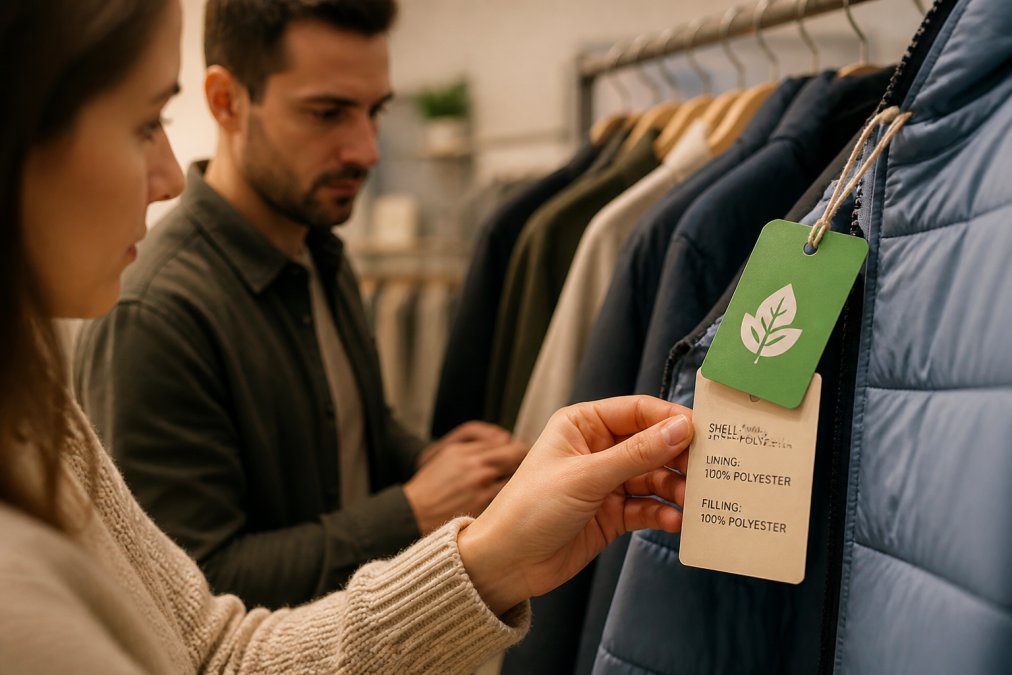
The most widespread example is the use of vague, unregulated terms. Words like "eco," "green," and "natural" carry no legal weight in the United States. A garment labeled "eco-friendly" may still be mostly petroleum-derived synthetics.
The fabric composition label is your first line of defense. If a product boasts sustainability but is mostly polyester, nylon, or acrylic, the claim is likely manufactured. Flip the tag and check percentages before reading the marketing copy.
Misleading Imagery and Single 'Green' Collections
Many brands create a small "sustainable capsule" collection while the rest of their output remains environmentally intensive. Earth tones, leaf graphics, and nature photography reinforce the deception.
Do the ratio calculation: if a brand sells 200 styles and only 5 are "sustainable," the other 195 items dwarf the positive contribution. A single "green" collection often distracts from textile production that relies on virgin, non-renewable resources.
How to Verify Clothing Brand Sustainability
Verifying sustainability claims requires active investigation. Beyond checking for quantified targets and published supplier lists, digital tools and lifecycle frameworks can give you a clearer picture.
Digital Verification Tools You Can Use Today
A new generation of digital tools aggregates data from public disclosures, certifications, and independent audits.
- Good On You: This app and website rates brands on a five-point scale using a proprietary algorithm weighing over 100 factors. While not perfect, it is a useful first filter.
- The Fashion Transparency Index: Published annually by Fashion Revolution, this index ranks 250 of the world's largest fashion brands on public disclosure of social and environmental policies. A brand that scores low is likely hiding something.
- The Higg Index: Developed by the Sustainable Apparel Coalition, this is a suite of tools brands use to measure their own impact. If a brand is unwilling to share its Higg data, its internal measurement is likely absent or unflattering.
- Certification Checkers: The websites of GOTS, OEKO-TEX, and the Fair Wear Foundation have searchable databases of certified brands and facilities, so you can verify a certification is current and covers the specific product.
The 'Greenwashing' Lifecycle: From Campaign to Systemic Change
Understanding where a brand sits on this journey helps you distinguish a marketing experiment from genuine transformation.
Stage 1: The Pilot Collection. The brand launches a small "sustainable" line using premium materials, typically a small fraction of the catalog. Its purpose is often to test consumer response and generate PR. This is not inherently greenwashing, but it is not evidence of systemic change.
Stage 2: The Public Commitment. The brand announces ambitious targets, such as carbon neutrality by a specific year. The key test is whether commitments are specific, dated, and tied to credible methodology.
Stage 3: Supply Chain Disclosure. The brand publishes its Tier 1 factories; advanced brands also disclose Tier 2 and Tier 3 suppliers. This transparency is expensive, which is why few brands achieve it.
Stage 4: Systemic Integration. Sustainability commitments are embedded in the core business model: targets tied to executive compensation, design teams trained in circularity, and efforts to reduce overall production volume.
Applying the Lifecycle Model
Ask which stage a brand occupies. A Stage 1 brand honest about its pilot program is not necessarily greenwashing; one that markets the pilot as proof of sustainability is. A Stage 3 or 4 brand demonstrates a commitment far more difficult to fake.
A practical test is to look for the names of specific mills or farms. If a brand only says "we source from ethical partners in Asia," that is public relations, not transparency. Genuinely committed brands can name their partners and welcome scrutiny.
Sustainable Fashion Certification Standards That Matter
Third-party certification is one of the most reliable ways to verify sustainability because it removes the brand's incentive to grade its own homework. Its credibility depends on the rigor of the auditing body.
When you see a certification label, check who issued it and what exactly it covers. Some certifications apply only to the fiber content, while others cover the entire manufacturing process. The distinction is critical: a fabric can be certified organic, but the garment could still be sewn in a facility with poor labor practices. For a deeper understanding of how these standards interact, the Textile Exchange's Material Baseline report offers detailed analysis on the prevalence of preferred materials in the market.
| Certification Focus | What It Verifies | Common Labels |
|---|---|---|
| Fiber Sourcing | Organic farming practices | GOTS, OEKO-TEX |
| Chemical Safety | Restricted substances in finished product | OEKO-TEX Standard 100 |
| Social Compliance | Labor conditions and wages | SA8000, Fair Wear Foundation |
| Environmental Management | Factory-level impact and waste | ISO 14001 |
| Circularity | Recycled content and design for recyclability | GRS (Global Recycled Standard) |
The Global Organic Textile Standard (GOTS) is widely regarded as the gold standard because it covers ecological and social criteria across the entire supply chain. Its presence signals genuine financial commitment. Be wary of in-house certifications not audited by an independent third party.
The Legal Landscape for Green Marketing Claims
The regulatory environment for environmental claims in the US is tightening. While the EU has adopted its Green Claims Directive, the US approach is a rapidly evolving patchwork of federal and state actions. Understanding this landscape lets you file a formal complaint that can trigger an investigation.
Federal Enforcement: The FTC and the Green Guides
The primary federal regulator is the Federal Trade Commission (FTC), which polices deceptive advertising under Section 5 of the FTC Act. Its Green Guides, updated in 2012, warn against unqualified claims like "eco-friendly" because they are nearly impossible to substantiate. The Guides also address specific issues:
- Recyclable claims: A product cannot be marketed as recyclable if the recycling infrastructure is not available to a substantial majority of consumers where it is sold.
- Carbon offsets: The FTC has scrutinized claims that rely on carbon offsets, requiring that the offsets actually represent real, additional, and permanent emissions reductions.
- Degradable claims: Products marketed as biodegradable must actually decompose within a reasonably short period of time under real-world conditions.
Recent FTC enforcement actions demonstrate a clear trend toward fining companies for unsubstantiated claims. In 2023, the FTC announced actions against several major retailers for falsely marketing rayon textiles as bamboo, fining them for deceptive environmental claims. The agency has also targeted "carbon neutral" claims that lacked a reasonable basis, signaling that vague terms without third-party verification are increasingly risky. The FTC's enforcement actions on deceptive environmental claims page is a public record of these cases, and it is worth searching before you buy from a new brand.
State-Level Action: The New York Model
In December 2023, New York enacted the nation's first law specifically targeting corporate climate claims. It requires large businesses to substantiate "net zero" and "carbon neutral" claims with a detailed, publicly available plan and grants the attorney general power to pursue civil penalties. Similar legislation has been proposed in California and other states.
If a brand's claim seems too good to be true, report it to the FTC or your state attorney general's office. A single investigation can result in significant fines and corrective advertising, making legal risk a genuine deterrent.
What This Means for Your Purchases
Legal accountability is now a tangible risk for brands. When you see a claim like "net zero by 2030," ask not just "is this true?" but "can this brand prove it under the new legal standards?" If it cannot point to a third-party-verified methodology, the claim would likely not survive scrutiny.
Your 5-Step Checklist to Spot Greenwashing in Fashion
Use this checklist every time you evaluate a new brand.
- Inspect the fabric composition label. If synthetics like polyester or nylon dominate, treat all environmental claims with extreme skepticism.
- Search for third-party certifications. Look for GOTS, OEKO-TEX, or B Corp logos. If you find none, look for a published supplier list or a sustainability report with specific, dated targets.
- Read the full sustainability page, not just the campaign. Look for quantified commitments involving carbon footprint, water usage, and textile waste.
- Evaluate the brand's overall catalog. Determine if the sustainable items are a small fraction of the total range. A fast fashion brand is not made sustainable by a five-item "eco" line.
- Check the imagery against the content. If the marketing relies on nature photography and green palettes while the data is absent, you are likely looking at greenwashing.
Conclusion: Shop With Evidence, Not Imagery
The challenge of identifying greenwashing will not disappear, but your ability to navigate it improves with each purchase. Genuinely committed brands welcome scrutiny; those that are not will obfuscate or rely on the emotional pull of green imagery.
At BALIVENO FASHION HOUSE LTD, we believe durability is the most sustainable quality a garment can possess. A piece that lasts for years reduces the demand for new textile production. Our focus on premium materials and timeless design is a direct response to the wastefulness of fast fashion.
Get started with BALIVENO FASHION HOUSE LTD and build a wardrobe that reflects your values through quality, not just labels.
Frequently Asked Questions
What are the most common examples of greenwashing in the fashion industry?
The most common examples include using vague terms like 'eco-friendly' or 'conscious' without evidence, highlighting a single recycled-material product while the rest of the line uses virgin synthetics, and using green color palettes or nature imagery to imply sustainability. Another frequent tactic is promoting a 'green' collection while the brand's core business model relies on fast fashion cycles. Look for specific data, third-party certifications, and supply chain details to see past the marketing.
How can I verify a clothing brand's sustainability claims?
Start by checking for third-party certifications like GOTS or OEKO-TEX, which involve independent audits. Look for specific percentages of recycled or organic fibers on the product page or hang tag. Read the brand's sustainability report for concrete targets and progress data, not just vague pledges. Ask customer service direct questions about material sourcing and factory locations. Finally, use tools like the FTC's Green Guides to understand what claims are legally acceptable in the US.
Why is vague terminology like 'eco-friendly' a red flag in fashion?
In the US, the FTC Green Guides state that broad claims like 'eco-friendly' are difficult to substantiate because almost every product has some environmental impact. When a brand uses such vague language without specifics, it often means they lack the data to back up a more precise claim. Specific terms like '100% organic cotton' or '50% recycled polyester' are verifiable. Vague terms are a warning sign that the marketing may be ahead of the actual sustainability practices.
What role does the FTC Green Guides play in regulating fashion marketing?
The FTC Green Guides are the primary set of rules in the US governing how companies can market environmental claims. They are not a certification standard but a framework to prevent deceptive advertising. They help define terms like 'recyclable' and 'compostable' and warn against unqualified claims like 'eco-friendly.' While the Guides are not a law themselves, the FTC can take action against brands under the FTC Act for claims that are misleading or unsubstantiated, making them a key reference for consumers.
This article was written using GrandRanker
