

Table of Contents
- Why Organic Cotton Matters for Sensitive Skin
- 1. Fewer Chemical Residues Against Your Skin
- 2. Naturally Hypoallergenic and Skin-Friendly
- 3. Breathability and Thermal Regulation
- 4. Softness That Reduces Friction and Irritation
- 5. Moisture-Wicking Comfort for Reactive Skin
- 6. Lower Risk of Contact Dermatitis and Eczema Flares
- 7. Organic Cotton vs Conventional Cotton for Skin
- How to Identify Genuine Organic Cotton Clothing
- Best Clothing Materials for Eczema
- The Environmental and Durability Angle
- Laundry Care for Sensitive Skin
- Frequently Asked Questions
Last Updated: September 12, 2026
Why Organic Cotton Matters for Sensitive Skin
If your skin stings, itches, or flares after wearing a new shirt, the fabric is often the culprit. This guide from Baliveno covers the 10 benefits of organic cotton for sensitive skin, starting with the most overlooked one: what conventional cotton carries into your wardrobe before it ever touches your body.
Conventional cotton is one of the most heavily sprayed crops in the world, and the residues that survive processing can sit against your skin all day. Organic cotton is grown without synthetic pesticides or genetically modified seed, which changes both the fiber itself and the way it is finished. For anyone with eczema, contact dermatitis, or a generally reactive skin barrier, that difference is not marketing. It is the whole point.
Below, we break down each benefit, the trade-offs worth knowing, and how to spot genuine organic cotton when you shop. Baliveno has built its everyday essentials around certified organic fibers, so we have a clear stake in this conversation, and we will be honest about where organic cotton falls short too.

1. Fewer Chemical Residues Against Your Skin
Organic cotton is grown without synthetic pesticides, and that single fact removes a whole category of residue from the fabric you wear next to your skin. Conventional cotton farming relies on chemical inputs that can leave trace residues through the textile processing chain, and those residues are a known irritant for people with chemical sensitivities.
The catch is that "organic" on a label is not self-enforcing. Certification is what separates a genuine claim from a marketing one. The USDA National Organic Program sets the rules for organic fiber claims in the United States, and independent standards like GOTS verify the full chain from field to finished garment.
Pros: Meaningfully lower exposure to pesticide residues; better for people with chemical sensitivities. Cons: Certified organic cotton costs more to produce, and that shows up in the price.
2. Naturally Hypoallergenic and Skin-Friendly
Organic cotton is naturally hypoallergenic, meaning it is far less likely to trigger an allergic reaction than many synthetic alternatives. The fiber is soft, breathable, and free from the chemical finishes that often cause irritation in conventional textiles.
That matters most for babies and young children, whose skin is thinner and more permeable. A review of textile contact dermatitis in the American Journal of Clinical Dermatology notes that clothing is a frequently overlooked trigger for skin reactions, particularly in children. Choosing a fiber with fewer finishing chemicals reduces one variable you can actually control.

Pros: Low reaction risk; suitable for babies and reactive adult skin. Cons: No fiber is truly allergen-free for every person, so patch-testing still matters.
3. Breathability and Thermal Regulation
Organic cotton breathes because of its natural fiber structure, which lets air move through the fabric and helps regulate your body temperature. This matters for sensitive skin because heat and trapped moisture are two of the most common triggers for itching and flare-ups.
Synthetic fabrics tend to trap heat and moisture against the skin. Natural fibers like organic cotton allow better airflow, which keeps the skin barrier calmer through the day. That is why breathability is one of the most practical benefits for anyone dealing with eczema or heat-triggered irritation.
Pros: Better airflow; reduces heat and sweat buildup that trigger itching. Cons: Very lightweight weaves may not hold warmth in cold weather on their own.
4. Softness That Reduces Friction and Irritation
Friction is an underrated trigger for sensitive skin. Rough fabric, stiff seams, and scratchy tags create the constant micro-abrasion that leaves skin red and reactive by the end of the day. Organic cotton tends to feel softer because it is often processed with fewer harsh chemical treatments, and the fiber itself is gentler against the skin.
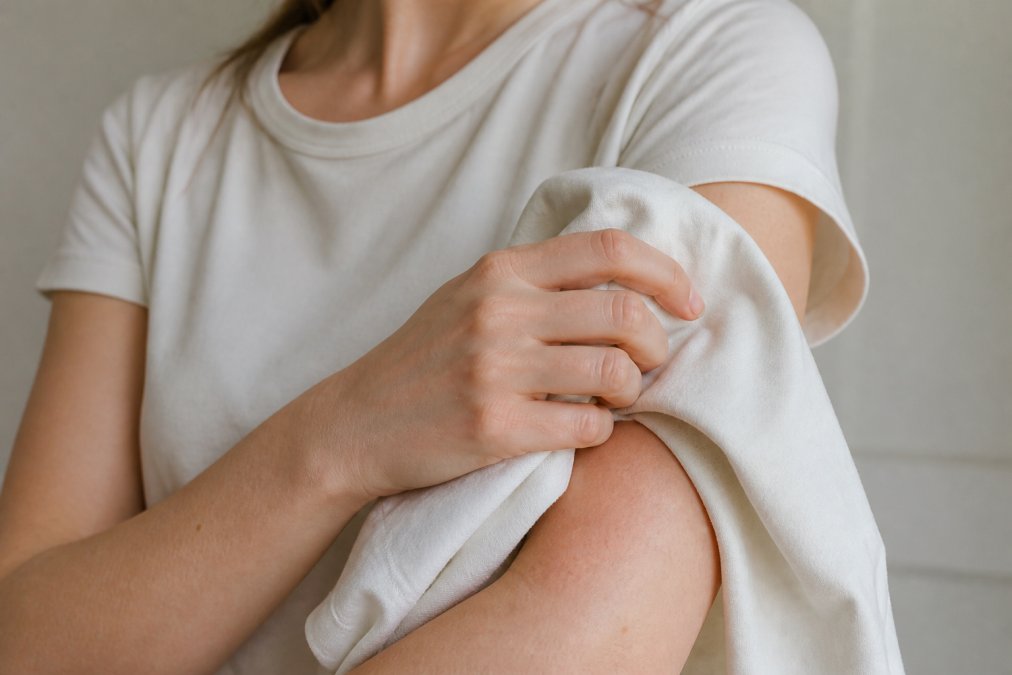
Pros: Less friction and chafing; gentler against compromised skin. Cons: Softness varies by weave, so a heavier knit will feel different from a light jersey.
5. Moisture-Wicking Comfort for Reactive Skin
Organic cotton wicks moisture away from the skin, which keeps the skin barrier drier and less prone to irritation. Trapped sweat softens and weakens the skin barrier over time, and that is exactly the environment where eczema and contact dermatitis thrive.
This is where organic cotton outperforms many people's expectations. It is not a performance synthetic, but its natural moisture management is enough for everyday wear, and it does the job without the chemical treatments some synthetic wicking fabrics rely on.
Pros: Keeps skin drier; reduces the moisture that weakens the skin barrier. Cons: Slower to dry than technical synthetics when soaked through.
6. Lower Risk of Contact Dermatitis and Eczema Flares
Choosing organic cotton reduces one of the most common environmental triggers for contact dermatitis and eczema flares. Contact dermatitis is an inflammatory skin reaction caused by direct contact with an irritant or allergen, and clothing is a frequent source.
For anyone managing a chronic skin condition, reducing trigger exposure is the daily work. A National Eczema Association overview of triggers and care points to fabrics and laundry products as common irritants. Organic cotton removes the fiber-side variable, though it cannot remove every trigger.
Pros: Fewer fiber-based triggers; a practical step alongside medical care. Cons: Laundry detergent and fragrance can still trigger flares regardless of fiber.
7. Organic Cotton vs Conventional Cotton for Skin
Organic cotton is grown without synthetic pesticides and GMOs and processed without many of the harsh chemical finishes used on conventional cotton, which makes it the better choice for sensitive skin. Conventional cotton is not inherently dangerous, but it carries more variables, and for reactive skin, fewer variables is the goal.
Here is how the two compare on the factors that matter most for skin:
| Factor | Organic Cotton | Conventional Cotton |
|---|---|---|
| Pesticide use | None synthetic | Commonly used |
| GMO seed | Prohibited | Common |
| Chemical finishing | Restricted | Less restricted |
| Best for | Sensitive, reactive skin | General, non-reactive skin |
| Cost | Higher | Lower |
If your skin is calm and uncomplicated, conventional cotton may be fine. If you flare regularly, organic is the safer default.
How to Identify Genuine Organic Cotton Clothing
Genuine organic cotton clothing carries third-party certification, not just a label claim. Look for GOTS or OEKO-TEX on the tag, and check that the certification covers the finished garment, not only the raw fiber.
- Look for a GOTS or OEKO-TEX certification number on the label
- Check whether certification covers the finished product or just the fiber
- Prefer brands that publish their supply chain and factory audits
- Be wary of "organic" with no certifying body named anywhere
- Confirm the fabric content percentage, since blends dilute the benefit
This checklist is the fastest way to separate real organic cotton from a greenwashed claim.
Best Clothing Materials for Eczema
The phrase "sensitive skin" hides three different problems, and they do not respond to fabric the same way. Matching the material to the actual condition is the angle most guides skip entirely.
Eczema (atopic dermatitis). The dominant trigger is a compromised skin barrier that loses moisture and lets irritants in. The priority is a fiber that stays smooth, breathes, and does not trap sweat. Organic cotton and Tencel lyocell are common first choices. Wool, even soft merino, is a coin flip: some people tolerate it, many do not, because the fiber's scale structure creates micro-friction on already-inflamed skin.
Contact dermatitis. This is an immune reaction to a specific substance, not a barrier problem. The trigger is usually a chemical, not a fiber: disperse dyes (common in dark and vivid synthetic blends), formaldehyde-based easy-care finishes, nickel in snaps and zippers, and rubber accelerators in elastic. For this group, the fiber matters less than the finish and the hardware. A certified organic cotton garment with a nickel snap can still flare; a conventional cotton garment with no finish and plastic hardware often will not.
Psoriasis. This is an autoimmune condition with rapid skin-cell turnover, and friction and trauma can trigger new plaques (the Koebner phenomenon). The priority is loose, smooth, non-abrasive fabric with flat seams and no scratchy tags. Breathability still matters for comfort, but mechanical irritation is the bigger lever here than chemistry.
A practical material ranking for reactive skin, from most to least forgiving:
- Certified organic cotton, smooth, breathable, low-finish, works for all three groups
- Tencel lyocell, very smooth, excellent moisture management, low finish
- Bamboo viscose, soft, but processing chemistry varies widely and certification is inconsistent
- Silk, smooth and temperature-regulating, but expensive and some people react to sericin residue
- Soft merino, fine for some eczema and psoriasis cases, risky for others
- Conventional cotton, acceptable if unfinishied and undyed, otherwise a variable
- Polyester and synthetic blends, trap heat and moisture, shed microfibers, and often carry disperse dyes
The rule that applies to all three: smooth over scratchy, breathable over occlusive, unfinishied over easy-care, and certified over claimed. Then patch-test on the inner forearm for 24 hours before committing a full wardrobe.
The Environmental and Durability Angle
Organic cotton supports healthier soil and is biodegradable at end of life, and it tends to hold up well because the fiber is not weakened by harsh processing. Environmental sustainability and fabric longevity are connected here: a garment that lasts longer and breaks down cleanly at the end of its life carries a lighter footprint.
One angle most guides skip: synthetic fabrics shed microplastics with every wash, and those particles end up in waterways. Natural fibers like organic cotton do not contribute to microplastic shedding, which is a quiet additional reason to choose them for a household with sensitive skin.
Durability depends on construction as much as fiber. Look for double-needle stitching and ribbed cuffs and hems, the details that keep a garment in shape wash after wash. Baliveno's kids organic cotton hoodie uses 2x2 ribbed cuffs and hem for exactly this reason.
Laundry Care for Sensitive Skin
How you wash organic cotton matters as much as what you buy. Residue from detergent, fabric softener, and fragrance is one of the most common causes of skin irritation, and it builds up in fabric over time.
- Use a fragrance-free, dye-free detergent
- Skip fabric softener entirely, since it coats fibers and traps residue
- Wash new garments once before first wear
- Avoid overloading the machine so residue rinses out fully
- Wash cool and hang dry to protect both the fabric and your skin
Frequently Asked Questions
Is organic cotton better for eczema-prone skin?
Organic cotton is often a better choice for eczema-prone skin because it is grown without synthetic pesticides and processed without many of the chemical finishes used on conventional cotton. These residues can trigger irritation and contact dermatitis in people with a compromised skin barrier. Organic cotton also tends to be softer, which reduces friction. It is not a cure for eczema, but many dermatologists suggest it as a first-layer fabric for reactive skin.
Does organic cotton contain fewer chemicals than conventional cotton?
Yes. Conventional cotton is one of the most pesticide-intensive crops in the world, and residues from synthetic fertilizers and processing agents can remain in the finished fabric. Organic cotton is grown without genetically modified organisms or synthetic pesticides, and certified organic processing restricts the chemicals allowed in dyeing and finishing. This means fewer chemical residues sit against your skin, which matters most for people with chemical sensitivities or a damaged skin barrier.
How does organic cotton differ from conventional cotton for skin health?
The main difference for skin health is what the fabric carries. Conventional cotton can hold trace residues from synthetic pesticides, chlorine bleach, and formaldehyde-based finishes. Organic cotton skips those inputs, so the final textile is cleaner against the skin. Organic cotton also tends to have longer fibers, which makes it softer and less likely to cause the friction that triggers irritation. For anyone with dermatitis or sensitive skin, that difference is often noticeable within a few wears.
Can clothing materials trigger skin allergies?
Yes. Contact dermatitis from clothing is well documented, and common triggers include dye residues, formaldehyde finishes, nickel hardware, and synthetic fibers that trap sweat. Wool and rough weaves can also cause mechanical irritation. If you react to a garment, check the fiber content and the certifications on the label. Switching to GOTS certified or OEKO-TEX certified organic cotton removes many of the most common chemical triggers in one step.
What makes organic cotton hypoallergenic?
Organic cotton is considered hypoallergenic because it is grown and processed without the synthetic pesticides, chlorine bleaches, and chemical finishes that cause reactions in sensitive people. Its natural fiber structure is breathable and moisture-wicking, so it does not trap sweat against the skin the way some synthetics do. It is also soft and smooth, which limits the friction that can set off itching. Look for GOTS or OEKO-TEX certification to confirm the fabric meets verified organic and safety standards.

EXPLORE THE BALIVENO EDIT
Continue the story
Discover a BALIVENO piece or collection related to the ideas in this article.
£35.94
Baliveno Drop Shoulder Cotton T-Shirt Explore all clothing

